
The Quality of Materials in an Oil Painting
The Support, the Ground, the Paints and the Varnish
by Alexandre Coxo, 23 February 2020
In short
- An oil painting has four components: support, ground, paint and varnish. How long it lasts depends on the quality of each and on the artist's procedures.
- Rigid supports are the safest in the long term, and aluminium is the best. For canvases, the best option is high-density linen on a hardwood stretcher.
- The ground isolates the support from the oil; acrylic grounds are best for long-term conservation.
- Handmade or premium paints have pigments with level I lightfastness (more than 100 years under museum conditions), but the deciding factor is how the painter uses them.
- Varnish protects the painting and should be removable, so that it can be replaced when it ages.
We usually expect an oil painting to stand the test of time. So when we buy one, it is important to know whether it has the quality needed to guarantee its longevity.
Of course, the longevity we look for will depend on what we want the painting for. We do not always want a work that will be a legacy for several generations. But we know that the more guarantees a piece offers, the more we will have to pay for it.
By the longevity of an oil painting we mean how long it lasts without change after it is made. For example, the lightfastness of pigments ranges from 2 years to more than 100 years.
With a basic understanding of the components that make up a painting, we can easily ask the right questions and assess the quality of its materials. This does not interfere with "style", as oil-based paints allow a huge variety of effects and finishes.
From "alla prima" painting to painting in layers, figurative or abstract, with thin or thick layers, oil offers high resistance to light and to changes in humidity and air temperature, as long as it is used with the right materials and procedures.
Fortunately and unfortunately, with the industrialisation of paint and other art material production, artists have drifted away from the knowledge needed to make the materials they use. This has made the industry the body that dictates the quality of what is used, setting ranges of quality and price that do not always serve painters well. Further on I will mention some brands and articles that can help us question artists about the various components of their work.
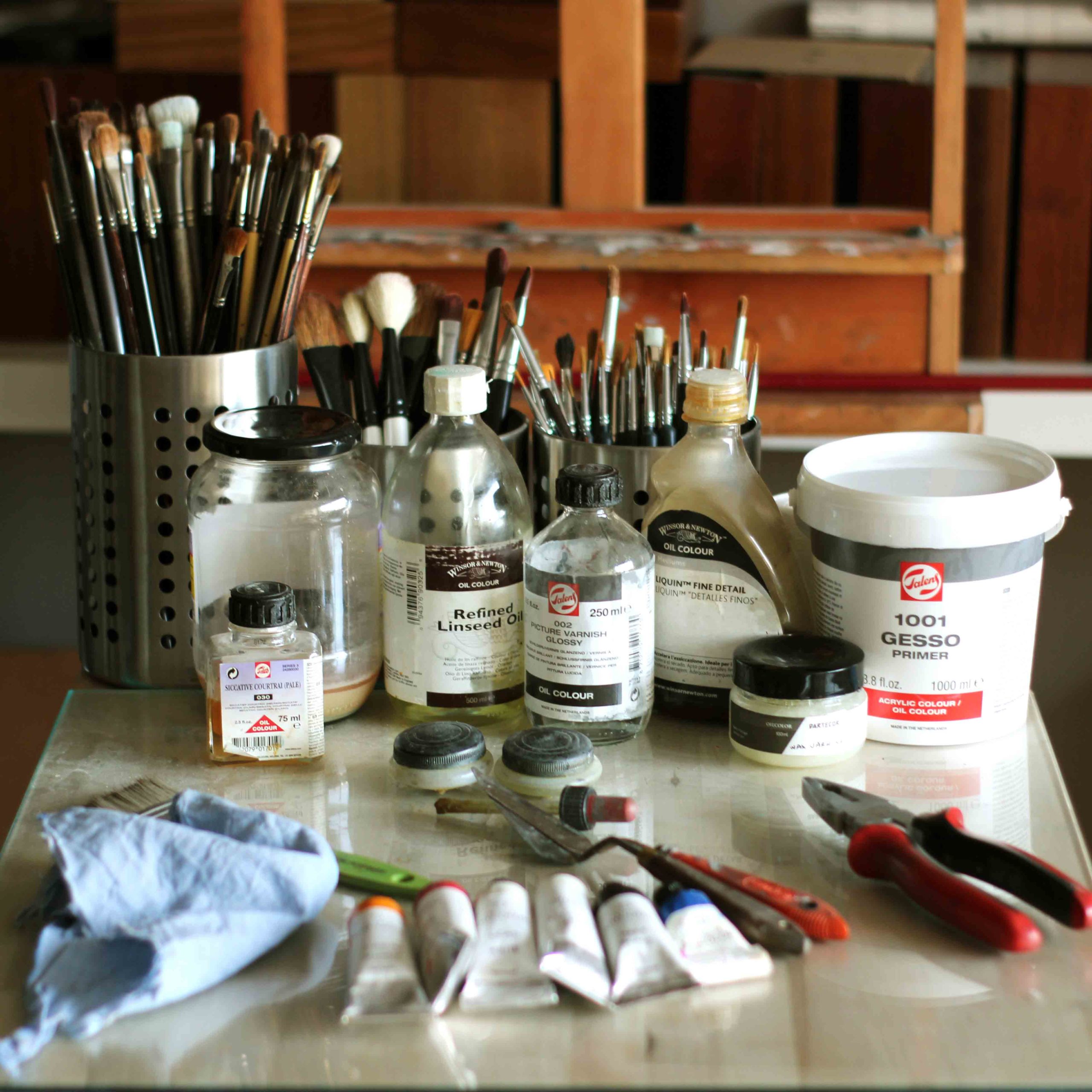
An oil painting is made up of 4 components. Its structure will be more stable and durable the higher the quality of each of them, and of the procedures they underwent during production and artistic creation. These components are: the support, the ground, the paint and the varnish.


The Support
Supports are the objects on which the painting is made and can be divided into rigid and flexible supports. In almost every case it is recommended that they be prepared with a ground or gesso before painting.
The ideal support material would not react with the paint, would not change size with humidity or temperature, would be easy to transport and would allow perfect paint adhesion. However, since we live on planet Earth, we have to make do with materials that have only some of these qualities and devise processes to work around their weaknesses.
Rigid supports are the safest option for long-term conservation. They can be made of metal, wood, cardboard and derived materials such as MDF or plywood.
The painting is more likely to last. Even where the paint is very thick, the mechanical strength of the support is always greater than that of the paint. However, rigid supports have three disadvantages: they take longer to prepare, they are more expensive and they are harder to transport.
Even so, for small or medium-sized works they are certainly the most suitable. In these cases transport is not really a problem!
Of all of them, aluminium is the best for oil painting. Its low density, good resistance to atmospheric corrosion, high thermal conductivity, non-toxicity and mechanical strength make aluminium supports light enough to be easy to transport and hang, and resistant to the various agents over time. Aluminium's only drawback is that it is more expensive. You can read more details in the article "Painting on Metal: An Introduction", by Mark Golden, 20 December 2016, by clicking here.
Wood or wood-derived supports are usually more affordable than metals and offer very good mechanical strength. However, they require more demanding ground preparation and a more careful sealing finish. If the quality of the wood and its preparation is good, we will certainly have a durable painting.
The oil paintings that have best withstood time were painted on wooden panels. A good example is "The Arnolfini Portrait" by Jan van Eyck. This painting dates from 1434 and is in excellent condition considering it is almost 600 years old. You can find more details on preparing panels for painting in the article "Painéis para Óleo e Têmpera" (Panels for Oil and Tempera, in Portuguese), on the Cozinha da Pintura website, 6 December 2010, by clicking here.
Flexible supports can be cloth or paper, with cloth canvases being the most common option today. Ease of transport and very affordable prices have made cloth canvas the most popular support. Once taken off its stretcher, a large canvas can be packed in a relatively small box and, with a skilled technician, re-stretched at its destination. This way we save twice: on the price of the support and on shipping.
But these advantages are not what ensures a painting's longevity. That depends on the stability of the fabric and how it is prepared. In theory any fabric can be used to make a canvas. However, if we want a durable painting, we must choose a hardwood stretcher and high-density linen, and trust that the way they were prepared ensures resistance to agents such as mould and humidity.
There are various types of cloth available, varying in fibre, density and preparation. Artists agree that linen is the fabric with the best properties, especially "Belgian linen", the canvas fabric most used in Europe and the USA. Linen has also been the most widely used since antiquity. However, its quality varies: the higher its density and the lower its elasticity, the better.
Assessing the quality of the cloth in a painting is difficult, so if you do not want to take risks, look for paintings on linen. For all intents and purposes it is the most used cloth in history, and if it looks similar to the image, you are halfway to a good reference. You can read more about canvas fabrics in the article "Tecidos para Pintura a Óleo" (Fabrics for Oil Painting, in Portuguese), on the Cozinha da Pintura website, 23 December 2010, by clicking here.
If you are thinking "How can I tell what the support is made of when I only see the painting from the front?", there is nothing better than picking up the work and looking at the back. If you do not feel comfortable doing so, and to avoid being impolite, ask the person in charge to do it for you.
The Ground
The ground prevents the paint from coming into direct contact with the support. In oil painting it is essential because oil oxidises rather than dries. As this reaction encourages the degradation of many supports, a layer must be applied to protect the support. The ground also has other functions, such as evening out texture and absorbency.
Many artists prefer to buy ready-prepared supports. Others prefer to create surfaces better suited to the kind of painting they do.
The viewer cannot identify this layer unless the artist leaves it visible. So it usually goes unnoticed and artists are rarely asked about it. Even so, the most attentive visitors to my studio ask about it.
Asking about this can catch the artist off guard and show that you are no ordinary enthusiast. It might be a way to get more careful explanations about their work and the processes they use. Although it has little bearing on the final look of the painting, it is certainly important for its conservation.
There are two main types of ground: traditional and synthetic. Traditional grounds are made of animal glue, gesso and pigment. They are more absorbent but less resistant to agents such as mould. Synthetic grounds are made of acrylic and pigment; they are less absorbent, more elastic and more resistant to external agents. Although brands add antibacterial and antifungal compounds when making traditional grounds, Virgil Elliott, among others, considers acrylic grounds best for long-term conservation.


The Paints
Oil-based paints were used long before Christ, and linseed oil became the dominant medium from the mid-17th century with the Flemish and Dutch masters.
Paints are made of pigments, oil, stabilisers and fillers. The Handmade or Premium paint brands offer the best quality. The most prestigious are: Michael Harding, Vasari, Robert Doak, Maimeri Puro and Williamsburg. Most of their pigments have level I lightfastness, meaning the colour lasts more than 100 years under museum conditions. These brands are also known for having the best pigment-to-oil ratio, always adjusted to the pigment and with the minimum of additives needed. This is what ensures the most stable paint layer.
I know, none of these is among the best-known or easiest-to-find brands, such as Winsor & Newton, Rembrandt or Schmincke. Even in their professional ranges, these brands offer standard products that meet the demand of a wide public. Even so, they advertise interesting guarantees that should be taken into account.
Allow me a note on the only Portuguese brand of oil paints: Dartecor. Although it is not in the top 5, in its favour it is a young brand. The paints have great covering power and are classified as Premium. It is the brand I use most, as it is the best I have access to. I hope time will bring it credit.
To produce longer-lasting paintings you need brands that guarantee paints with quality pigments and the best medium-to-pigment ratio. In cheaper paints, brands add fillers to reduce the amount of expensive components and even out the texture of the colours. This forces artists to use more layers of paint, or thicker layers, losing control over the effects they want and increasing the risk of cracking.
Even so, when it comes to paints, the most decisive factor is the artist's procedure. However good the paint, if it is used with too much oil it will produce an uneven paint film. If it is used with too much thinner, there is no guarantee the pigment will bind.
That is why another point to consider is the quality of the "medium" used during the painting process. Without going into its variations and rules of use, the medium is made of oil and thinner and should be used as sparingly as possible. More experienced artists make their own medium because they know what properties the paint needs for their style of painting.
The most common oil is linseed oil. Safflower, poppy, sunflower and lavender oils can also be used. The most common thinner is turpentine, of plant origin. Other options are white spirit and Sansodor (petroleum-derived). Pure or mixed, they allow variations in drying time, paint thickness and colour vibrancy.
Asking artists about their approach to the paints and medium they use is probably the only way to assess how long the paint layer will last. Even so, there is plenty of room for mistakes and innovation in painting technology. An artist who keeps up to date may be the best bet.
The Varnish
Varnish is a resin applied over the painting. Although it is an optional finish, it offers many advantages.
Its quality depends above all on its durability and permanence. Durability refers to changes in transparency and elasticity over time: a good varnish should stay translucent and colourless for a long time. Permanence reflects how the varnish bonds to the paint, determining whether it can be removed. Ideally, removable varnishes should be used, so that when they age they can simply be removed and replaced without risk of damaging the painting.
The most obvious advantage of varnish is protecting the painting from physical damage such as that caused by insects or abrasion. Varnish also isolates the painting from the air, protecting it from changes in humidity, dust and pollution. This makes cleaning and maintaining the painting safer. Remember that if someone uses the wrong product to clean a painting, it will be damaged forever if it has no varnish.
Another function is to even out colour saturation. Oil colours become duller as they dry, and this is more visible in some pigments than others. Varnish creates a "wet" look, saturating the colours as if they were not yet dry. This way a painting can always look as splendid as when it was just finished.
Manufacturers offer varnishes with different finishes, from matte to gloss. This variety is purely aesthetic, so we can choose a varnish that ensures quality while flattering the painting and suiting the space it is intended for.
There are varnishes with natural and synthetic resins; the choice is a matter of taste. However, especially with synthetic resins, it is advisable to choose brands from companies known for their research, such as Gamblin, Golden, Royal Talens or Winsor & Newton. Be wary of general-purpose varnishes or ones not made specifically for oil painting.


In this article I have tried to give buyers and painting enthusiasts information on how to assess the quality of the materials in an oil painting or, at least, on how to ask the right person.
When you visit a painter's studio you will see first-hand the kind of materials they use and the experiments they carry out. With the knowledge in this article, you will quickly see the quality and whether a particular work meets your goals.
Fortunately and inevitably, advances in science and technology bring new knowledge, calling some earlier ideas into question and confirming others. So there will always be room to question the quality of materials and the guarantees artists give. A good example is the current debate about the longevity of organic pigments. Here is here the link to an article by George O'Hanlon, on this issue.
Frequently asked questions
What are the components of an oil painting?
Four: the support (what you paint on), the ground (the layer that isolates the support from the paint), the paint and the varnish. The higher the quality of each, and of the procedures used to make the painting, the more stable and durable it is.
What is the best support for oil painting?
Rigid supports (metal, wood and wood-derived materials) are the safest for long-term conservation, and aluminium is the best of all: light and resistant to corrosion and ageing; its only drawback is that it is more expensive. The oil paintings that have best withstood time were painted on wood, such as Jan van Eyck's «The Arnolfini Portrait» (1434). Among flexible supports, high-density linen is the fabric with the best properties.
How can you tell what a painting's support is made of?
By looking at the back of the work. If you do not feel comfortable picking it up, ask the seller to do it for you.
Which oil paint brands are the best quality?
The most prestigious are Michael Harding, Vasari, Robert Doak, Maimeri Puro and Williamsburg: most of their pigments have level I lightfastness and the best pigment-to-oil ratio. Dartecor, the only Portuguese oil paint brand, is classified as premium and is the one Alexandre Coxo uses most. Even so, the most decisive factor is the procedure: too much oil or too much thinner compromises the paint layer.
Does an oil painting need varnish?
It is optional, but it has many advantages: it protects against physical damage, isolates the painting from humidity, dust and pollution, makes cleaning safer and evens out colour saturation. Ideally use a removable varnish from a recognised brand such as Gamblin, Golden, Royal Talens or Winsor & Newton; be wary of general-purpose varnishes.
What is the difference between a traditional and a synthetic ground?
A traditional ground is made of animal glue, gesso and pigment: more absorbent but less resistant to mould. A synthetic ground is made of acrylic and pigment: less absorbent, more elastic and more resistant to external agents, which is why it is better for long-term conservation.
Share your opinion or your questions by leaving a comment in the form below.
If you are interested in buying art but do not yet feel confident, share your doubts: I will do my best to help and to reply as quickly as possible!
You may also be interested in:
-
Introdução à Pintura – WPO Ebook
7,40€ Add to cart -
Materiais e Ferramentas – WPO Ebook
3,90€ Add to cart -
Métodos de Pintura – WPO Ebook
7,40€ Add to cart -
Paleta e Mistura de Cores – WPO Ebook
3,90€ Add to cart -
Composição e Pintura de Paisagem – WPO Ebook
7,40€ Add to cart -
Método Direto – WPO Ebook
3,90€ Add to cart

